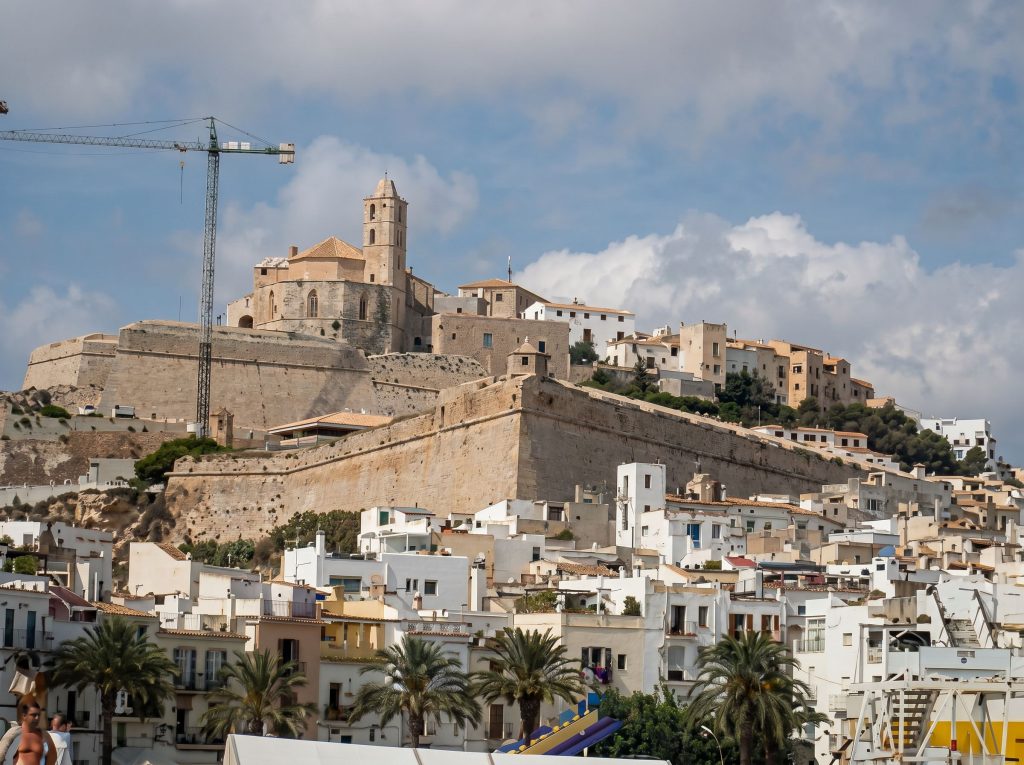
Most people arrive in Ibiza with a very specific itinerary: land, drop your bags, and head straight to a daybed in Playa d’en Bossa or a terrace at Amnesia. I get it. But if you skip the island’s capital, Ibiza Town—locally called Eivissa—you are missing the actual soul of the place. This is where 2,500 years of history crash headlong into modern Mediterranean chaos.
Scaling Dalt Vila
You will feel the history of Dalt Vila (the High Town) in your calves. This UNESCO-protected walled city sits on a steep hill, and passing through the dramatic Portal de les Taules gate with its massive stone ramp and original drawbridge slots feels like walking onto a 16th-century film set.
Inside, it is a maze of whitewashed houses, heavy wooden doors, and trailing bougainvillea. Walk up Carrer de Sant Ciriac. The cobblestones here have been polished to a slick, slippery sheen by centuries of foot traffic. I’ve seen countless tourists twisting ankles in wedge heels—wear proper trainers. The climb is steep and sweaty, but it pays off when you reach the bastions. Looking out over the red rooftops to the marina below is exactly what you want after a long ascent, preferably with a €4 glass of local hierbas poured over ice at a small corner café.
Sacred Spaces and Ancient Bones
At the very top sits the Cathedral of Our Lady of the Snows. It is a 13th-century Gothic-Catalan fortress of a church built directly over an old Roman temple. It feels heavy and permanent, a stark contrast to the seasonal pop-up clubs down on the coast. Just a few streets away, the Church of Santo Domingo is completely different, full of Baroque domes and frescoes left behind by the Dominican order.
If you want something genuinely fascinating and slightly eerie, walk outside the main walls to the Puig des Molins necropolis. It is a massive ancient Phoenician cemetery. For an entry fee of about €2.40, you can climb down into the burial caverns. It is usually empty, heavily air-conditioned in the museum portion, and provides a quiet break from the midday sun.
Sa Penya to the Superyachts
Directly below the medieval walls is Sa Penya, the old fishermen’s quarter. It is tight, loud, and brilliant. During the day, it is a sleepy cluster of independent shops selling raw leather bags and silver rings. By 10 PM, streets like Carrer de la Mare de Déu are packed shoulder-to-shoulder. Bars spill out into the alleys, and you will find drag queens, locals, and club promoters all fighting for the same square foot of pavement.
Follow the water, and the gritty charm of Sa Penya abruptly shifts into Marina Botafoch. This is the glitzy stretch of promenade where the superyachts dock. Expect to pay €18 for a cocktail while sitting at waterfront spots. It is home to high-end dining concepts—including spaces made famous by collaborations between Ferran Adrià and Cirque du Soleil—where people-watching the international jet-set is the main event.
The Ferry Hub (and a Warning)
The harbour acts as your main exit strategy when you need a change of pace. Modern ferries leave constantly for the neighboring island of Formentera. The fast ferry takes 35 minutes and costs around €50 return. A quick warning: avoid the standalone Euronet ATM machines near the ferry ticket booths. They will hit you with a massive withdrawal fee and terrible exchange rates. Walk ten minutes back into town and find a standard CaixaBank or Santander instead.
This port also connects you back to the mainland, with massive car ferries chugging out daily to Denia and Barcelona, plus routes across to the larger Balearic island of Mallorca.
How to Actually Time Your Visit
Do not attempt the Dalt Vila climb at 2 PM in August. You will melt. Arrive around 6:30 PM when the stone walls start throwing long shadows. Wander up to the top, grab a drink to watch the light change over the water, and then walk back down into Sa Penya for dinner.
In peak season (June through September), walking into a decent restaurant at 7:30 PM will get you weird looks; kitchens really hit their stride at 9:30 PM, and dinner reservations are entirely non-negotiable. While walking the old town is free, bring a handful of coins for the smaller museum entries, lace up a pair of shoes with actual grip, and take your time navigating the steep inclines.