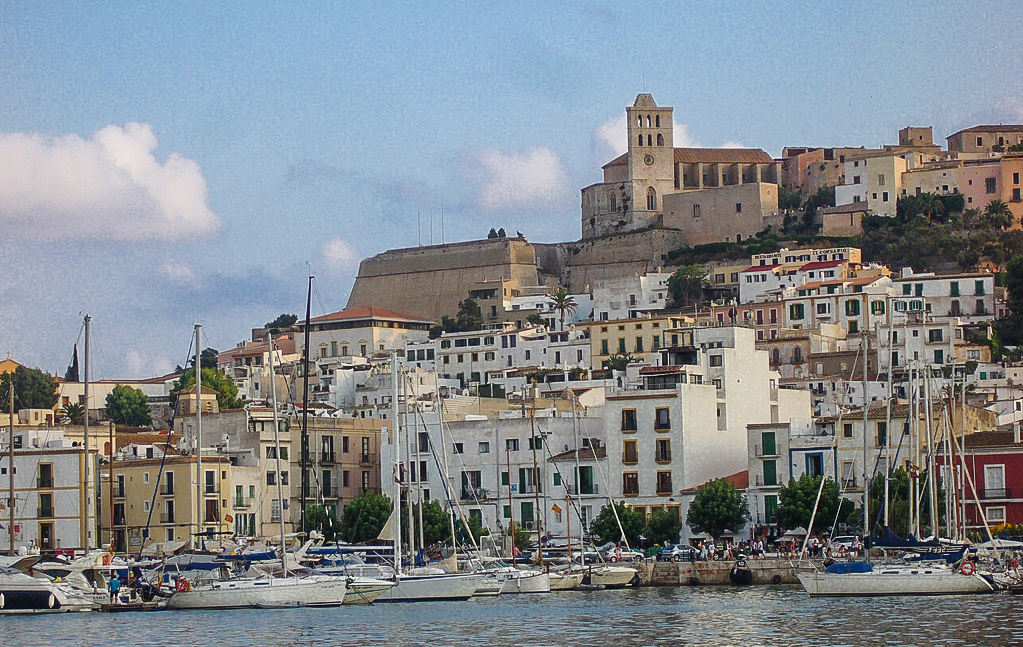
Ibiza Town goes by Eivissa on local street signs. This is the capital of the island. You walk on streets built by Carthaginian settlers and defended by Renaissance soldiers. Decades later 1970s counterculture icons turned the old town into a massive party hub. It’s a highly practical base if you want to rely on the main port and skip renting a car for a few days.
Inside the Walls of Dalt Vila
You start the climb at the Portal de ses Taules. This massive stone gateway cuts straight through the old defense walls. Italian engineer Giovanni Battista Calvi originally built these bastions under orders from King Philip II to keep pirates out of the harbor, and today they give you an entirely unobstructed view across the water to the neighboring island of Formentera. The walk up is steep. I highly recommend thick-soled shoes because the cobblestones get painfully uneven near the top.
Whitewashed mansions and small art galleries line the route up. At the very top sits the Cathedral of Santa Maria d’Eivissa. The exterior is heavy Baroque architecture built directly over original 13th-century Catalan Gothic foundations. Right next door is the Archaeological Museum. You can see physical artifacts tracing the island’s timeline from the early Phoenician settlement at Sa Caleta up through Roman occupation, assuming you want a break from the midday sun outside.
Sa Penya and La Marina
Down at sea level the old fishermen’s quarters stretch along the harbor. La Marina and Sa Penya completely changed character in the 1960s when artists moved into the cheap waterfront housing. The bohemian spirit from that era stuck around.
La Marina borders the water. You can grab a coffee on the promenade and watch the mega-yachts pull in. Sa Penya sits just behind it on slightly higher ground. The streets here are incredibly narrow. Some alleys are barely wider than your arm span and packed with tiny boutiques and tapas bars. This whole zone serves as the traditional LGBTQ+ center of the capital. Things get loud after dark. People spill out of places like Bar La Marina to watch the crowds walk by until early morning. And the noise just bounces off the old stone walls.
Booking Passage at the Port
Puerto de Ibiza operates as the main transit hub for the island. Ferries and high-speed catamarans leave from these docks constantly. You can catch a quick ride over to the beaches on Formentera or book longer passages to mainland Spain. Routes run regularly to Denia and Valencia. Or catch a connection to the other Balearic Islands if you have the patience to sit on a slow boat all day. The modern marina handles everything from private sailboats to commercial transit.
South to Ses Salines
The urban grid ends just south of the city limits. Here the land flattens out into Ses Salines Natural Park. Workers have harvested salt from these flats since the Phoenicians controlled the island. You’ll see migratory birds passing through the wetlands. Flamingos feed in the shallow water.
Flat dirt trails run along the salt pans for cycling or walking. The water reflects a very specific pink color right at sunset. The park borders Platja d’en Bossa and the quieter coves of Es Cavallet. You get a real sense of scale walking out here compared to the cramped alleys of the old town. It makes a lot of sense why they protected the natural salt resources with the exact same UNESCO status as the military fortress.