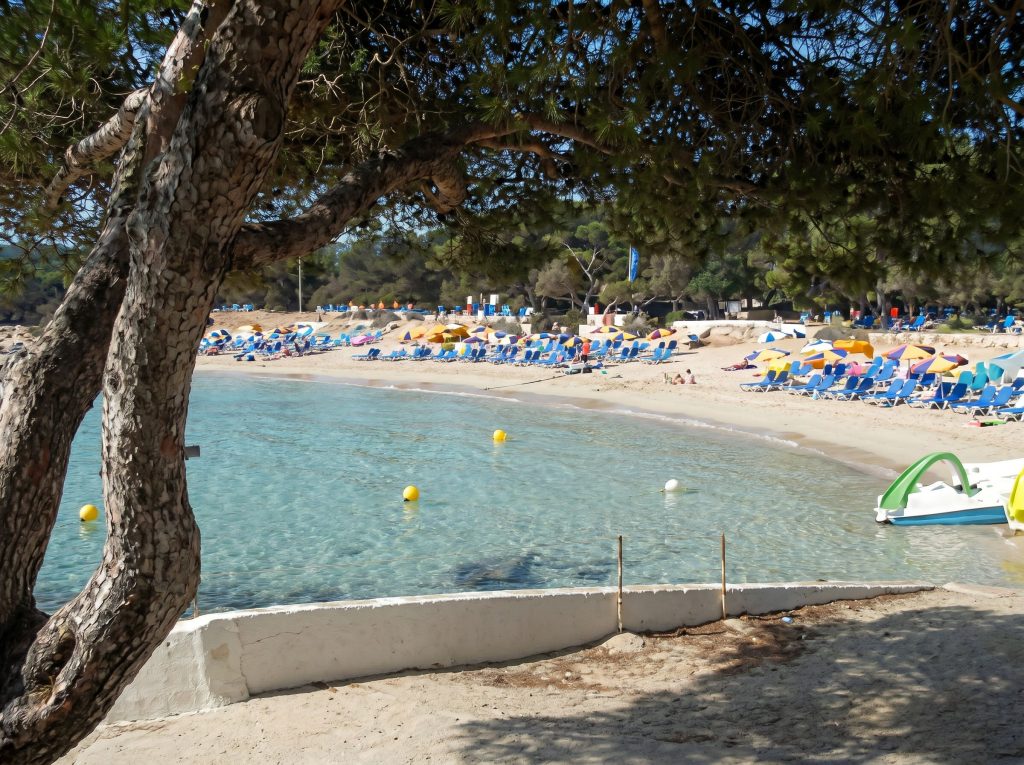
If you’ve seen a postcard of Ibiza’s west coast, you’ve probably seen Cala Bassa. It’s the beach everyone talks about, and for good reason: the sand is ridiculously fine, the water is a hyper-saturated shade of blue, and old, twisted Sabina pine trees grow right down to the shoreline. But because it’s no secret, doing Cala Bassa right requires a bit of tactical planning. Show up at 2 PM in mid-August without a plan, and you’ll be circling the dust-choked dirt parking lot while your rental car’s AC struggles to keep up. Get it right, though, and it’s easily one of the best days you can spend on the island.
What to Expect on the Sand
The defining feature of Cala Bassa isn’t just the water—though the clarity here is pool-like, thanks to the sheltered, shallow curve of the bay. It’s the trees. A dense canopy of ancient pines borders the entire 250-meter stretch of sand. Their roots are exposed along the back of the beach, providing a natural, fragrant canopy that feels like an absolute godsend when the midday Balearic sun hits 34 degrees.
Because the seabed shelves very gently, the water is usually dead calm. You won’t find massive waves here, which makes it incredibly easy to just float for hours. Remarkably, despite the heavy foot traffic it sees every summer, the local council has kept the surrounding skyline completely free of high-rise hotels. You are looking at water, sand, and forest.
How to Actually Get There (and Where to Park)
Cala Bassa is roughly a 15-minute drive from San Antonio, but your journey depends entirely on your timing.
- By Car or Scooter: The road in (the PM-803) is straightforward, but the final stretch gets bottlenecked. There is a massive dirt parking lot right behind the trees. It costs €5 for the day, and the attendants usually hand you a voucher for a free bottle of water at the beach club. In July and August, this lot is effectively full by 11:30 AM. Arrive by 10:00 AM if you want a space in the shade.
- By Ferry: Honestly, this is the best way to arrive. The little yellow and red ferries leave from the San Antonio marina (right near the famous egg roundabout) every hour or so during peak season. A return ticket is around €12. It takes 20 minutes, you skip the traffic entirely, and getting dropped off right in the shallows feels incredibly cinematic. Just note that the last boat back is usually around 6:30 PM, and it is always packed. Don’t push your luck on the timing.
- By Bus: The L7 bus runs from the San Antonio bus station directly to the beach. It’s cheap (roughly €3 each way), but in peak summer, expect to be standing in the aisle holding onto a pole while the bus navigates tight corners.
CBbC, Food, and Renting a Pedalo
You can’t talk about Cala Bassa without talking about the Cala Bassa Beach Club (CBbC). It essentially monopolizes the back half of the beach beneath the trees. It’s broken up into different sections—a high-end restaurant, a sushi bar, and a massive expanse of sunbeds. Expect deep house beats drifting over the sand and a lot of oversized sunglasses.
Be prepared for the prices. A standard pair of wooden sunbeds with a parasol will run you upwards of €60 for the day, and you absolutely need to book these online weeks in advance for mid-summer. The food is excellent, but a standard burger or club sandwich will easily clear €25.
If you prefer to keep things low-key, do what the locals do: bring a cooler packed with jamón, fresh bread, and cold drinks from the Mercadona in San Antonio. Nobody will bother you if you lay your towel on the public sand right in front of the water.
If you get bored of lying flat, the water sports hut at the southern end has you covered. You can rent paddleboards for about €20 an hour. The classic choice, though, is the pedalo with the built-in slide. It’s aggressively retro and totally worth the €25 rental for the sheer entertainment value. Lifeguards are stationed on the sand from late morning until 6 PM.
Walking to Cala Roja
If the main beach gets too claustrophobic, pack up your towel and walk north along the coastal path. After about 15 minutes of dodging low-hanging branches and navigating the rocky headland, you’ll hit Cala Roja. It’s not a sandy beach—it’s a small, craggy inlet with deep, clear water that is perfect for snorkeling. You’ll often spot people cliff-jumping from the lower rock ledges here. Just do yourself a favor and wear actual trainers for the walk; trying to hike over jagged limestone in wet flip-flops is a guaranteed way to ruin your afternoon.
A Few Practical Tips Before You Go
- The Signal Black Hole: 4G and 5G reception can be notoriously patchy under the thickest part of the trees. If you need to coordinate meeting friends, send your texts before you leave San Antonio.
- Bring Cash: While the beach club takes cards, those mobile signal drops mean the wireless card machines occasionally fail. Plus, you’ll want €5 or €10 in coins for the wandering vendors selling incredibly refreshing slices of cold melon and pineapple on the sand.
- The September Sweet Spot: If you have the luxury of choosing your dates, come in the third week of September. The water is still bath-warm from the summer heat, the parking lot is half-empty, and the chaotic energy of August has completely dissipated.
- Stay for the Afternoon Fade: Because of the way the bay curves, you won’t get a direct view of the sun dropping into the ocean, but the sky turns a brilliant, bruised purple around 8 PM. The beach club DJs usually shift to downtempo tracks, the crowds thin out, and you get to enjoy the water at its absolute quietest.
Recommended experiences
A few bookable experiences related to this topic: